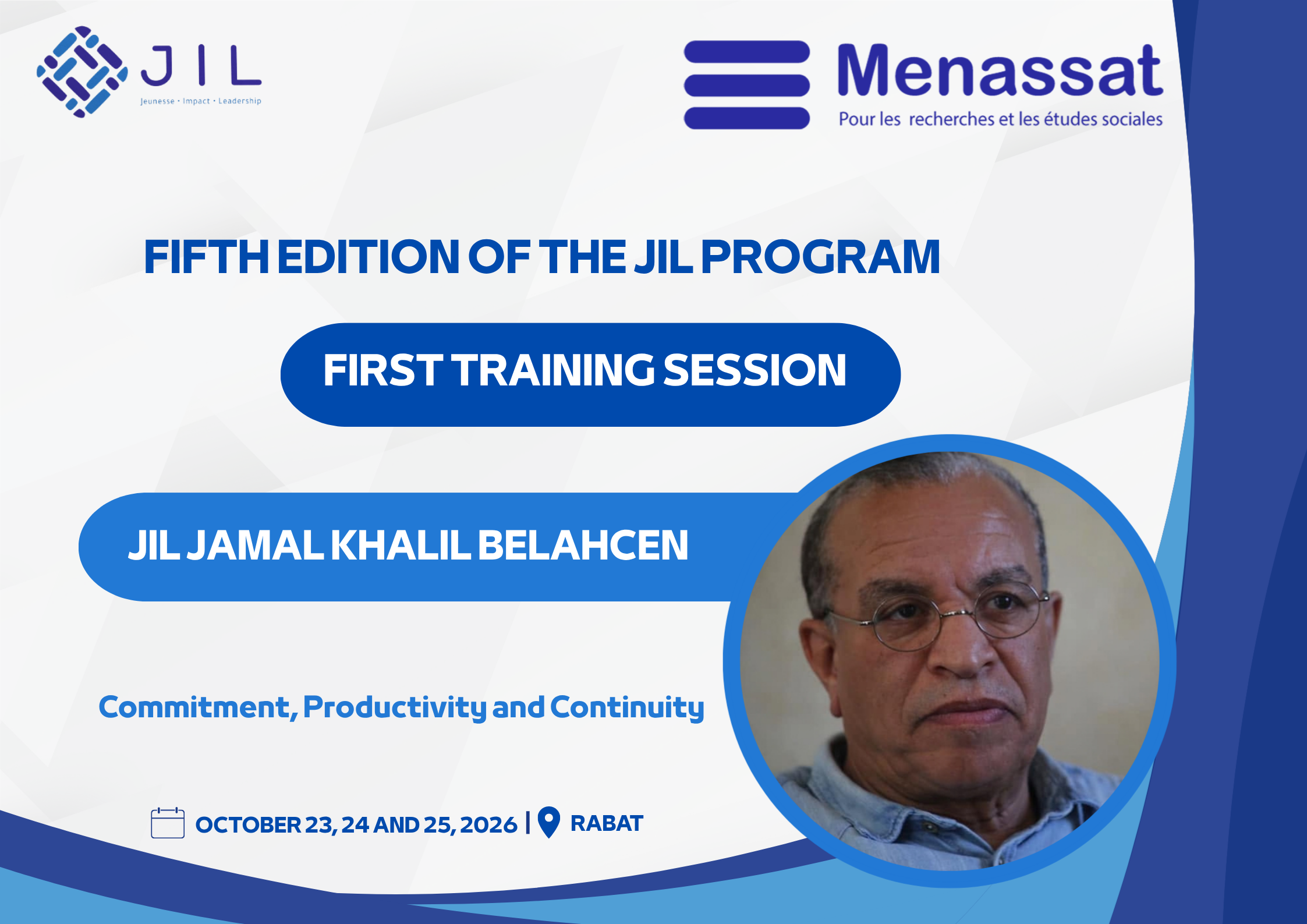
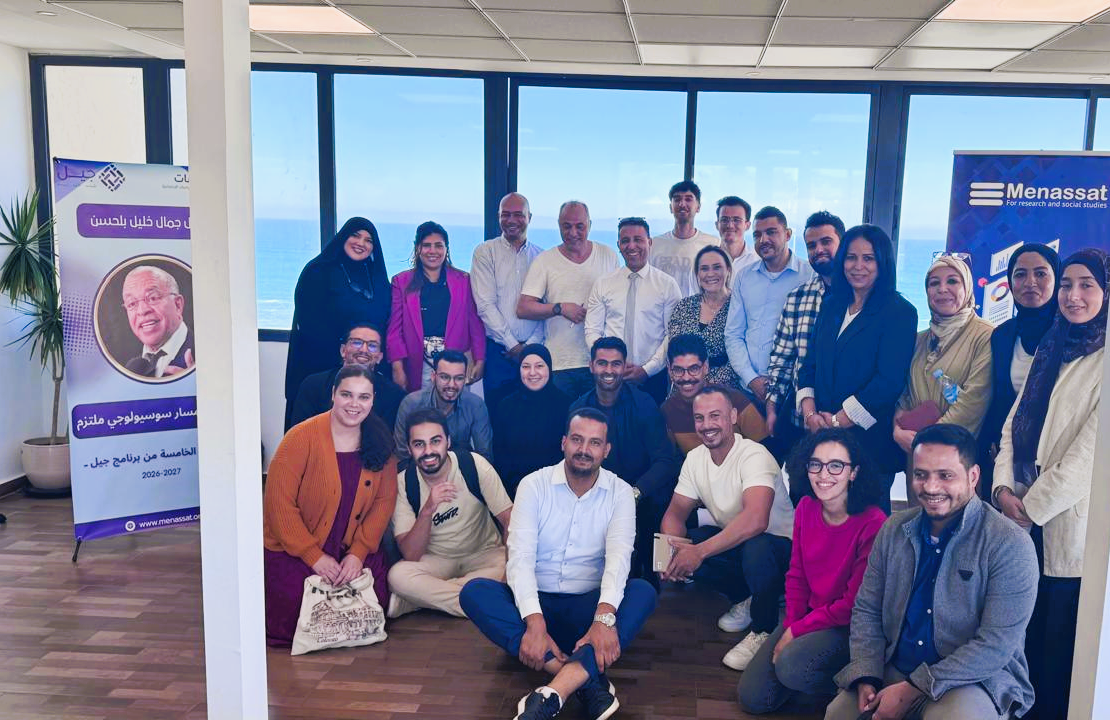
The Menassat Center for Research & Social Studies concluded the first training session of the 5th edition of its “Jil” programme on Sunday, October 25, 2026. The programme is named after the Moroccan sociologist Jamal Khalil Belahcen and brought together 25 researchers from universities across Morocco. The three-day session, held between Casablanca and Rabat, is part of a year-long training programme that aims to strengthen young researchers’ methodological and intellectual skills and enhance their ability to produce scientific knowledge that engages with societal issues and transformations.
The programme opened on Friday, October 23, at the Mohamed Sekkat University Library in Casablanca, where Professor Jamal Khalil Belahcen delivered an inaugural lecture titled “Citizenship and Knowledge.” The lecture examined the relationship between a researcher’s intellectual construction and their responsibility as a citizen. He declared that a researcher’s identity is not built with degrees alone, but rests on intellectual curiosity, independent thinking, fieldwork experience and openness to others. He also stressed that citizenship is a practice and a responsibility toward a shared existence, and that scientific research requires taking truth as a compass, revisiting preconceived ideas and moving beyond premade answers, while combining intellectual freedom with ethical responsibility. In this view, the researcher is not detached from society but seeks to understand it critically and to contribute to its main causes.
The programme continued in Rabat with a series of academic and practical sessions. Professor Ikram Adnani, lead researcher at the Center and professor of political sciences at Ibn Zohr University, presented the Center’s vision, values and objectives. Graduates of previous sessions, Samira Tazrout, Ayoub El Kayssi and Achraf Amhaouch, shared their experiences, strengthening the exchange between different generations of researchers and fostering the continuity of the programme.
On methodology, Professor Bouchaib Majdoul, lead researcher at Menassat and professor of sociology at Ibn Zohr University, addressed the path from an initial question to the construction of a problem statement. Professor Aziz Mechouat, director of the Menassat Center and professor of sociology at Hassan II University of Casablanca, led a workshop on sociological research and teamwork, in which participants worked on proposing research topics to be developed in the coming phases of the programme.
The programme also featured a lecture by Mohamed Abdelwahab Rafiki, a researcher in Islamic thinking, on the religious phenomenon from the perspective of Menassat’s research, followed by a discussion with participants on how it can be studied through the social sciences approaches.
The session closed with a workshop on policy papers led by Professor Mustapha El Mnasfi, professor of political sciences at Moulay Ismail University and an expert in the field, which focused on turning research findings into practical conclusions and recommendations that can feed into public policy debate.
This session aligns with the Menassat’s aim to make JIL’s program a space for training, scientific production and collaborative work, building a bridge between acquiring research tools and building research projects, and between academic knowledge and understanding societal issues.
Through this year-long program, Menassat is also seeking to support young researchers and develop their capacities to produce robust scientific knowledge and contribute to public debate.