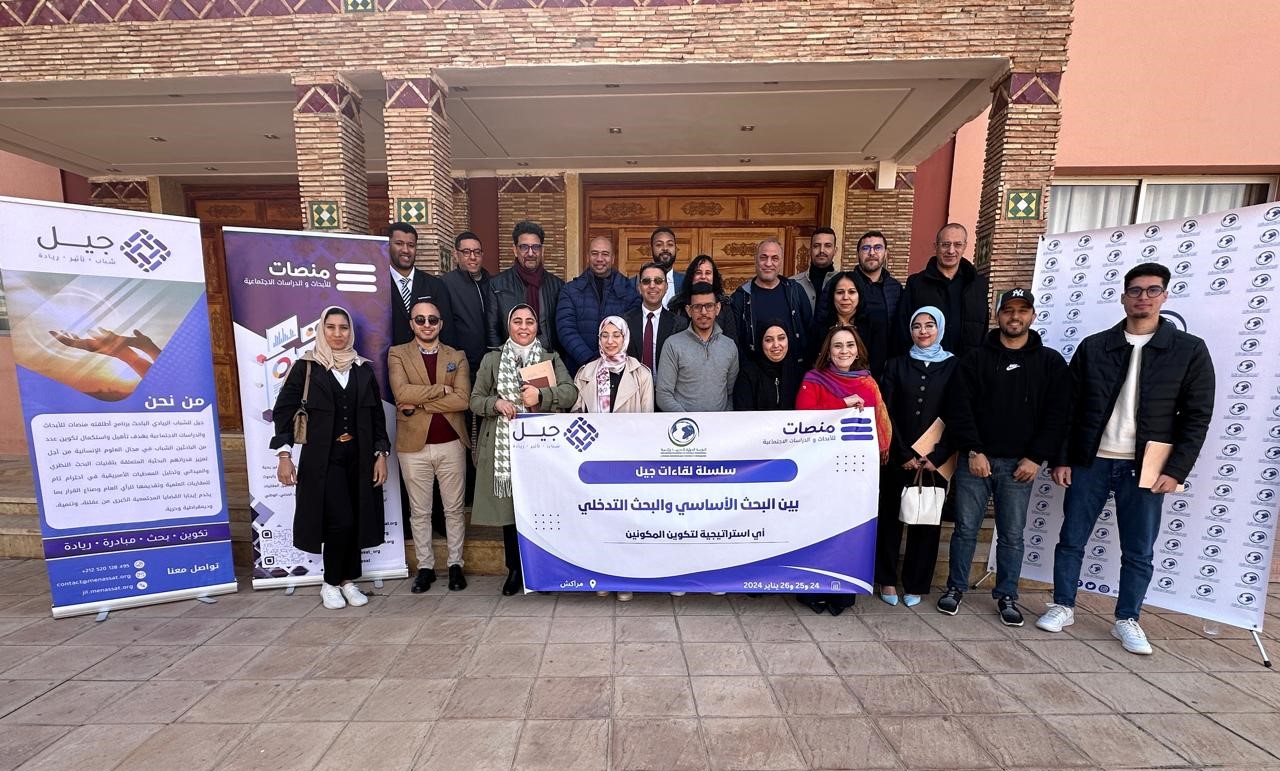
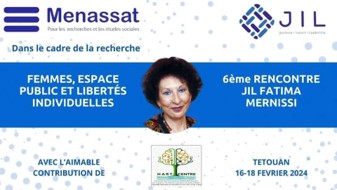
In the continuation of the JIL Program in its third version, the Menassat Center for Research and Social Studies is organizing the sixth in-person training session for young Moroccan doctoral students.
Event Details
The activity is scheduled for February 16, 17 and 18, 2024, at the MAKARIM hotel in Tetouan, and will include a close contribution from the HART Center for Social Studies, Research and Development, based in the same city. With the active presence of Menassat director Aziz Mechouat and several members of the same center, the training will provide an opportunity to call on several academics, experts and professors, including:
● Ms. Khadija Rabbah: founding member of the Democratic Association of Moroccan Women, expert in gender and international consultant.
● Dr. Aourraz Rachid: founding member of the MIPA Institute and expert in writing policy papers.
● Bouchaib Majdoul: sociologist and research professor at Ibn Zohr University.
● Several other professors and academics from the HART Center.
Program Objectives and Methodology
Spanning two days, the training session will revisit the progress of the policy papers, which participants have been introduced to several times as part of the JIL program by the best Moroccan experts in the field. The objective is to involve these young doctoral students at the heart of public debates, to take part in decisions on public policies, particularly through the acquisition of advocacy techniques, and to be able to engage in dialogue with institutional actors through policy briefs. The training will also revisit the progress of the literature reviews through workshops scheduled for this purpose, alongside the steps to follow for processing and analyzing quantitative data. As a reminder, the JIL program, now in its third version, was initiated by the Menassat Center with the aim of complementing the university training of young Moroccan researchers. On both the theoretical and practical levels, young researchers are trained in field research techniques and in the tools appropriate to any scientific approach. Beyond the academic dimension, young people are introduced to advocacy techniques that enable them to become directly involved in ongoing societal debates and dialogues. The ultimate objective is to lead young people to build bridges toward institutional actors, around a constructive dialogue drawn from scientific foundations, using policy papers as the means.